
Identity and access
Assess whether account design, MFA usage, privilege separation, admin exposure, and access discipline are strong enough to reduce the most common business-critical attack paths.
See where cybersecurity risk can affect the business, what deserves attention first, and what leadership should do next.
NetSentinel helps turn cybersecurity findings into business consequence, priority, ownership, remediation discussion, conscious deferral where appropriate, and executive decision support.
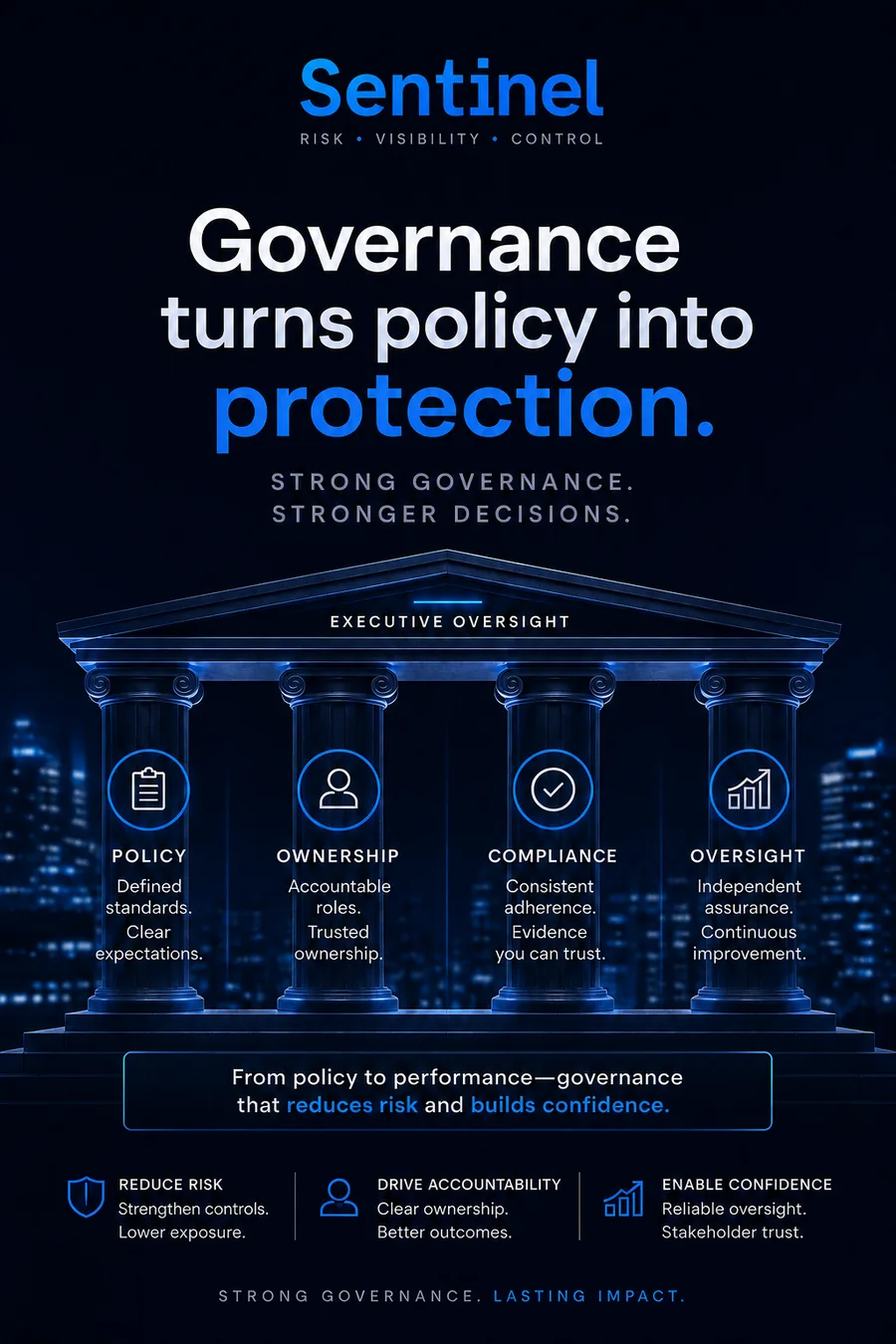
NetSentinel's cybersecurity risk assessment service is designed to answer a business question, not just a technical one.
This is not generic “peace of mind” language and it is not a loose control checklist. It is a structured view of cybersecurity exposure framed in terms leadership can use.
If you are still deciding what a cybersecurity risk assessment is, start with the educational guide. For the broader picture beyond cybersecurity, see the six-pillar technology risk assessment.
It helps leadership understand:
This service is best suited to organizations that need clearer cybersecurity decision support, not just more raw technical output.
It is a strong fit for:
It is not for every situation. If the real need is continuous monitoring, exploit validation, formal audit evidence, or outsourced operations, a different tool or provider may be more appropriate.
Smaller organizations comparing options can also review the small business cybersecurity risk assessment.
The assessment is focused on the areas most likely to shape real business exposure, including:
The objective is not to produce noise. It is to show which weaknesses matter, how they combine, and where leadership should focus.
Even when the immediate concern is cyber exposure, the underlying risk picture often connects to the other NetSentinel pillars:
Identity, endpoint, control, and monitoring weaknesses create direct attack paths.
Backup and recovery weakness changes the consequence of a security incident.
Unsupported systems, brittle dependencies, and weak architecture can increase cyber exposure.
Unclear ownership and weak policy discipline make known risks harder to address.
Microsoft 365, SaaS, permissions, and sharing models often expand exposure quickly.
Poor data governance and permission sprawl can expand downstream AI-related security risk.
This page stays focused on the cybersecurity service. If the real question is broader executive technology-risk visibility across all six areas, the better fit is the master Technology Risk Assessment.
Assess whether account design, MFA usage, privilege separation, admin exposure, and access discipline are strong enough to reduce the most common business-critical attack paths.
Assess whether managed devices, patching, supported systems, encryption, and endpoint-protection discipline reduce unnecessary exposure.
Assess whether cloud identities, permissions, external sharing, SaaS growth, and configuration decisions create oversharing or control gaps.
Assess whether underlying infrastructure and network decisions make the environment easier to compromise, harder to recover, or more difficult to govern.
Assess whether the backup design, credential separation, restore confidence, and recovery assumptions reduce or amplify incident consequence.
Assess whether suspicious activity is likely to be noticed, escalated, and handled with enough clarity and ownership.
Assess whether vendors, SaaS tools, and external access pathways introduce meaningful risk without enough visibility or control.
Assess whether the organization can clearly explain who owns cybersecurity decisions, what gets prioritized, what is deferred, and how leadership stays informed.
The output is designed to support executive understanding and next-step decisions.
Depending on scope and fit, the engagement supports outputs such as:
The point is not to hand leadership a pile of technical fragments. The point is to make the risk picture usable.
Establish whether the organization needs executive cybersecurity-risk visibility, and where the current uncertainty sits.
Review the most relevant cybersecurity-risk areas to understand where the business is materially exposed.
Turn technical weakness into business consequence, urgency, ownership, and decision context.
Use the assessment outputs to support remediation planning, ownership discussion, deferral logic, and leadership decision-making.
This is an assessment and decision-support engagement. It is not a managed security operation.
NetSentinel is the executive layer above IT for technology-risk visibility. In the cybersecurity context, that means helping leadership understand where risk sits, how serious it is, and what deserves action first.
NetSentinel does not:
That boundary makes the service more credible, not less. It keeps the page honest about the problem NetSentinel is built to solve.
Many organizations already have tools, alerts, reports, or outside IT support.
The harder problem is usually not the existence of technical data. It is the translation gap between technical detail and executive action.
NetSentinel's role is to make that translation layer visible and usable.
That gap creates practical business problems:
Use a penetration test when the main goal is adversarial testing or exploit validation.
Use a vulnerability scanner when the main goal is recurring automated discovery of known weaknesses.
Use a compliance platform or formal audit when the main goal is evidence collection, framework alignment, or certification support.
Use an MSP or internal IT team when the main goal is operational execution, implementation, remediation, and ongoing support.
Use NetSentinel when the main goal is executive cybersecurity-risk visibility, prioritization, ownership, and decision support.
If leadership needs clearer visibility into cybersecurity exposure, stronger prioritization, and better next-step decisions, this is where the conversation should start.