
Technology Risk Assessment Checklist 2026
Published:
A complete technology risk assessment checklist should span infrastructure, cybersecurity, resilience, cloud, governance, and AI readiness so leadership can evaluate where the business is truly exposed—not just where technical controls are easiest to count.
This is the broadest and most strategic checklist in the cluster because technology risk rarely lives in one pillar only.

Statistics Canada reported that 16% of Canadian businesses were impacted by cybersecurity incidents in 2023, while Uptime Institute’s 2024 outage analysis found that 54% of respondents said their most recent significant outage cost more than $100,000. The Canadian Centre for Cyber Security’s Ransomware Threat Outlook 2025 to 2027 says ransomware will likely remain a significant threat to Canada over the next two years. Together, those findings support the cross-pillar approach in this checklist: business exposure rarely sits in only one technology domain.
How to use this checklist
This checklist is designed to help leadership and technically fluent readers evaluate the whole exposure picture, not just one control category at a time. The point is to ask whether the organization can explain how each pillar is governed, how the pillars interact, and which weaknesses deserve attention before they combine into a larger business problem.
Strong answers usually reflect cross-functional visibility. Weak answers usually reflect silos: security knows one part, infrastructure knows another, operations knows a third, and leadership never receives a clear integrated view. That is exactly the gap a technology-risk framework is meant to close.
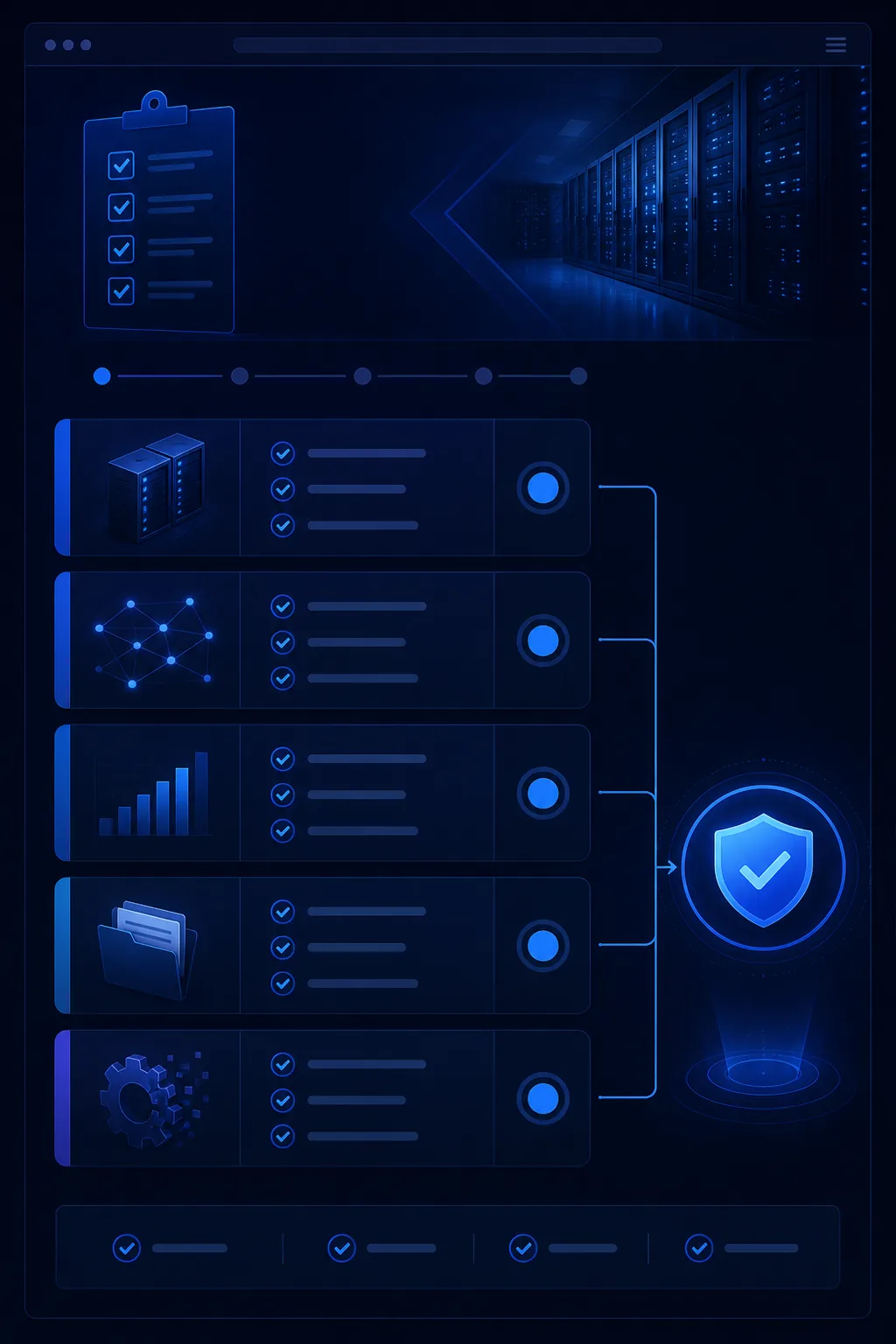
1. Infrastructure checklist
Review whether critical systems are supportable, documented, resilient, and sized for current business demands.
Infrastructure matters because it shapes continuity, supportability, and the business’s ability to grow without hidden fragility. If the environment is brittle, under-documented, or heavily dependent on aging platforms, that weakness can amplify issues in every other pillar.
2. Cybersecurity checklist
Check whether identity, endpoint, backup security, monitoring, and cloud access controls reduce the most likely exposure paths.
Cybersecurity should be evaluated as a control system, not just a tool stack. Strong answers here reflect not only security products but also sound identity design, clear ownership, recovery resilience, and operational discipline.
3. Resilience checklist
Validate whether backup, recovery, continuity planning, recovery objectives, and testing are strong enough to support real operational recovery.
Resilience is where the business learns whether its recovery assumptions are credible. A backup that exists but is untested, a plan that exists but lacks ownership, or a restore path that nobody has validated can quickly change the consequence of a disruption.

4. Cloud checklist
Assess whether cloud identity, permissions, external sharing, app integration, and governance practices are keeping pace with usage.
Cloud exposure often expands through convenience. As SaaS adoption, collaboration, and AI tooling grow, cloud control needs to keep pace or the business may discover too late that access and governance drift outpaced oversight.
5. Governance checklist
Confirm whether ownership, policy, vendor management, approvals, and risk review processes are clear enough to support consistent decision-making.
Governance is what connects technical reality to executive accountability. If ownership is unclear, approvals are informal, or deferred risks disappear from view, other strengths in the environment become harder to sustain.
6. AI readiness checklist
Review whether governance, data handling, permissions hygiene, vendor discipline, and staff expectations are strong enough for safe AI use.
AI readiness matters because AI tends to accelerate whatever access, data, and governance conditions already exist. Poor discipline here can turn existing weaknesses into much more visible business problems.
When a full technology risk review is needed
A broad review is especially useful when:
- leadership wants one coherent view of exposure across the business
- the organization has grown in complexity
- risk conversations are happening in isolated silos
- security, resilience, governance, and cloud issues are interacting with each other
- the business needs clearer executive prioritization before committing budget
These situations all signal the same underlying issue: exposure is no longer narrow enough to understand in isolated reviews. The business needs a more integrated explanation of how conditions across multiple pillars affect continuity, confidentiality, governance, and investment decisions.
What strong and weak answers usually indicate
Strong answers suggest the organization has enough visibility to connect technical conditions to executive priorities.
Weak answers usually suggest fragmentation. Controls may exist, but nobody can explain the full picture clearly enough for leadership to decide what matters first. That is when a cross-pillar assessment becomes far more useful than another siloed review.
What current evidence suggests
Statistics Canada reported that 16% of Canadian businesses were impacted by cybersecurity incidents in 2023, while recovery spending rose to about $1.2 billion.
That matters because technology exposure has direct business consequences that are not confined to one technical silo.
Uptime Institute found in 2024 that 54% of respondents said their most recent significant outage cost more than $100,000.
That reinforces why infrastructure, resilience, and recovery deserve attention alongside cybersecurity.
The Canadian Centre for Cyber Security’s Ransomware Threat Outlook 2025 to 2027 says ransomware will likely remain a significant threat to Canada over the next two years.
That supports a cross-pillar perspective because ransomware consequences often depend on security, backup, governance, cloud, and recovery conditions together.
The evidence supports the same conclusion as the checklist itself: business exposure rarely stays inside one technology category for long.
Frequently asked questions
Final takeaway
The most common mistake in technology-risk review is treating cybersecurity as the whole conversation. A complete view needs to connect all six pillars because that is how exposure behaves in the real world.

Begin with a full Technology Risk Assessment.
If you want the clearest starting point for understanding technology exposure across the business, begin with a full Technology Risk Assessment.