
What Is a Cloud Security Assessment?
Published:
A cloud security assessment evaluates whether identities, permissions, sharing settings, SaaS controls, recovery assumptions, and governance practices are strong enough to support secure cloud operations.
That matters because cloud risk is rarely just a platform issue. It is usually a combination of configuration risk, permission risk, governance drift, and operational habits that grew faster than oversight.

Microsoft said in its 2025 Digital Defense Report that identity-based attacks rose 32% in the first half of 2025 and that more than 97% of those attacks were large-scale password-based attempts. Microsoft Research has also found that multifactor authentication can prevent over 99.2% of account compromise attacks. Those are useful reminders that cloud exposure often concentrates first around identity, permissions, and access design.
Why cloud security needs a broader view
Cloud platforms make collaboration easier, but they also concentrate risk.
Email, files, identity, external sharing, connected applications, and increasingly AI-enabled workflows can all depend on the same environment. If access design is loose or governance is weak, one poorly controlled area can affect several others.
That is why cloud security should not be reduced to a score, a migration checklist, or a one-time hardening exercise.
Cloud platforms usually become more important over time, not less. Email, file access, external collaboration, identity, mobile productivity, connected apps, and increasingly AI features can all depend on the same control model. That means weak governance in one area can affect several others. A cloud assessment matters because it shows whether the environment has become more central to the business than its control discipline has kept pace with.
What a serious cloud assessment reviews
A strong cloud assessment should examine how the environment behaves in practice.
That includes:
- identity and admin-role design
- MFA and conditional-access maturity
- external sharing and guest access exposure
- third-party app connections and consent risk
- SaaS sprawl, approval discipline, and offboarding gaps
- data protection, retention, and cloud backup assumptions
- governance practices that determine whether controls hold up over time
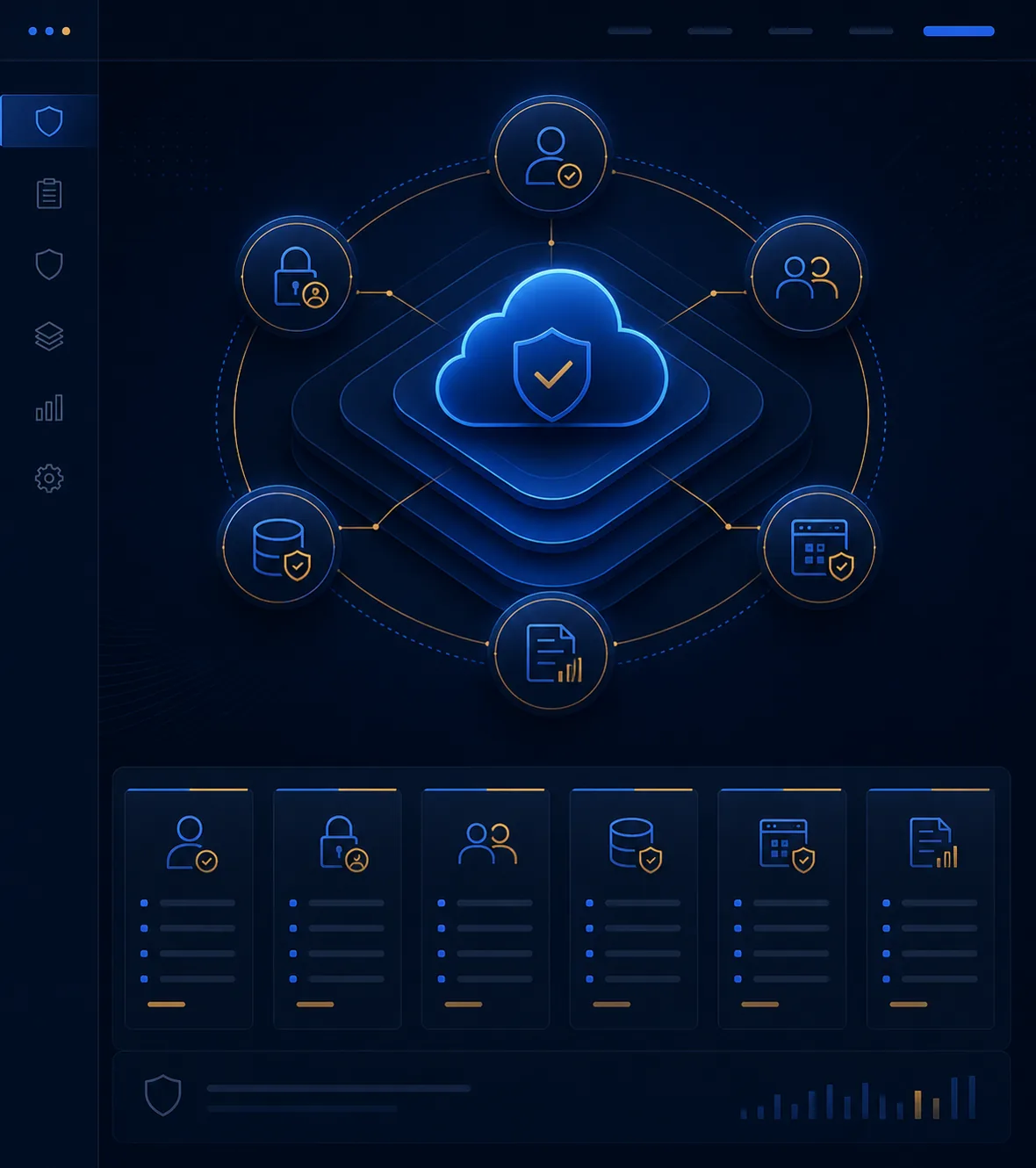
Those are not separate checkboxes. They interact. For example, a business may have MFA but still carry too many administrators. It may control guest access in one workload but not another. It may trust the provider for resilience without having thought through its own data-protection or recovery responsibilities. An assessment is useful because it looks at those combined conditions rather than treating each control in isolation.
How it differs from a scorecard
A scorecard can be useful, but it is not the same as a risk assessment.
A score can show activity, incomplete configuration work, or alignment to one model. A cloud security assessment goes further. It asks whether control design is strong enough for the business, whether real exposure paths remain open, and whether leadership has enough visibility to prioritize improvement.
That difference matters because leadership decisions are rarely made on score alone. Leaders need to understand business consequence. They need to know whether oversharing, weak admin design, inconsistent offboarding, or under-governed SaaS growth could create confidentiality, continuity, or governance problems that deserve action now.

Who should consider one
A cloud security assessment is especially useful for:
- Microsoft 365 and SaaS-heavy businesses
- internal IT teams managing fast cloud growth
- MSPs and advisors who need stronger client-facing risk translation
- leadership teams preparing for broader collaboration, compliance pressure, or AI rollout
It is also useful for organizations that feel they have “good enough” cloud security but struggle to explain why. When confidence depends more on assumptions than on visible review discipline, a more serious assessment usually becomes worthwhile.
What good cloud maturity looks like
Good maturity does not mean every risk is removed. It means the business can explain its identity model, privileged-access controls, sharing standards, SaaS approval process, recovery assumptions, and ownership structure clearly enough that leaders can make informed decisions about remaining exposure.
Poor maturity usually looks different. Controls may exist, but ownership is fuzzy. Settings may be enabled, but exceptions have multiplied. Sharing may be convenient, but no one is quite sure where the highest-risk content lives or how broadly it is visible. The purpose of an assessment is to make that difference visible.
When to reassess
Cloud environments should be reassessed after meaningful change, including:
- large migrations
- major growth in SaaS usage
- expansion of external collaboration
- restructuring of identity and device policy
- planned AI deployments that rely on existing permissions hygiene
Reassessment also makes sense after mergers, vendor transitions, major permission cleanups, or any period where SaaS growth happened faster than review discipline. Cloud risk is dynamic. A previously acceptable control model can become weak simply because the business changed around it.
What the data suggests
Microsoft said in its 2025 Digital Defense Report that identity-based attacks rose 32% in the first half of 2025.
That matters because cloud environments often use identity as the primary control layer across multiple business-critical services.
Microsoft also reported that more than 97% of those identity-based attacks were large-scale password-based attempts.
That reinforces why access design, authentication quality, and privilege discipline belong at the center of cloud-risk conversations.
Microsoft Research found that multifactor authentication can prevent over 99.2% of account compromise attacks.
That does not solve every cloud issue, but it is strong evidence that identity maturity materially affects exposure.
These facts support the same conclusion as the broader manuscript: cloud security is not only about the provider’s platform. It is also about whether the customer’s identity, permissions, governance, and data-handling model are strong enough for the way the business operates.
Frequently asked questions
Final takeaway
Cloud providers secure their own infrastructure. That does not guarantee your tenant, permissions model, collaboration design, or governance discipline is where it needs to be.

Start with a Cloud Security Assessment.
If your environment has grown faster than its control model, start with a Cloud Security Assessment before weak assumptions become business exposure.