
What Is Business Resilience Planning?
Published:
Business resilience planning is the discipline of making sure the organization can continue operating, recover critical systems, and coordinate decisions under disruption. It is broader than backup, and it matters because operational recovery is ultimately a business capability, not just an IT function.

The Canadian Centre for Cyber Security identifies ransomware as the top cybercrime threat to Canada’s critical infrastructure, and Uptime Institute’s 2024 outage analysis found that 54% of respondents said their most recent significant outage cost more than $100,000. Together, those findings support the same resilience argument: disruption is not theoretical, and recovery confidence must be earned through planning, sequencing, and testing.
Why resilience matters to leadership
Every organization depends on technology, vendors, people, and documented processes to keep operating. When disruption happens, leadership needs more than proof that backup software exists. It needs confidence that the business can absorb the disruption, recover in the right order, and make decisions without confusion.
That is why resilience planning matters. It connects technical recovery to business continuity.
The distinction matters because leadership usually experiences disruption through decisions, not through system logs. Which service returns first? Who speaks to customers? What can the business do manually? Which vendor becomes critical? How long can revenue-generating work pause before the impact becomes material? Resilience planning exists to answer those questions before they are urgent.

What resilience planning actually covers
A serious resilience program should look at:
- backup coverage and recovery integrity
- disaster recovery design and technical restoration sequence
- business continuity planning for people, operations, and communications
- recovery objectives such as RTO and RPO
- dependency mapping across systems, vendors, and workflows
- ownership, escalation, and decision-making during disruption
- testing evidence, not just documented intentions
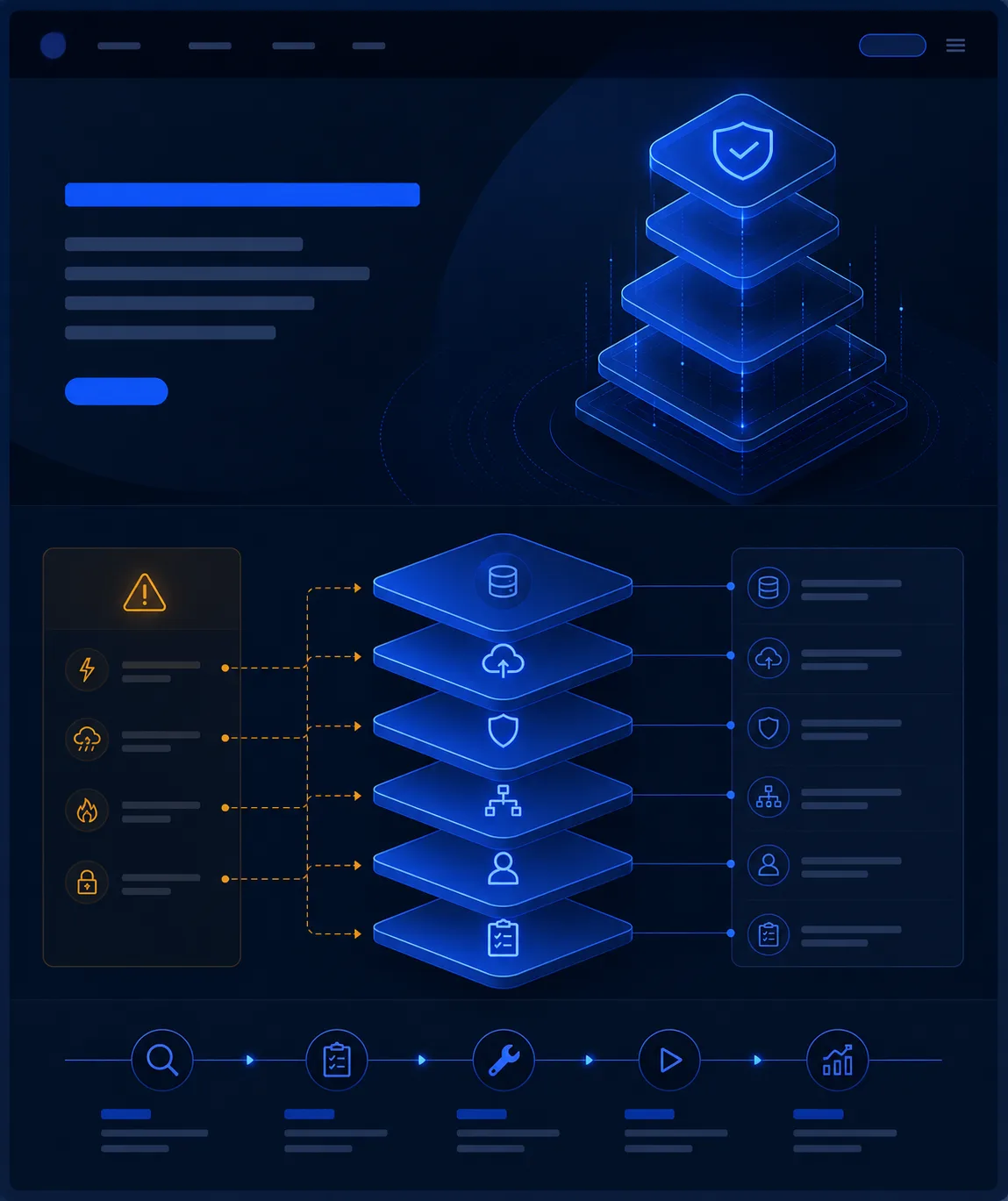
Backup is one control inside resilience, not the definition of resilience.
That is where many organizations oversimplify the subject. They know they have backups, so they assume resilience is largely handled. In reality, recovery depends on whether backups are usable, whether restoration order is understood, whether the right people can make decisions quickly, and whether business operations can continue while systems are being restored.
Where organizations get this wrong
Many businesses have some combination of backups, vendor assurances, and continuity notes, but those elements are not always connected well enough to support a real recovery.
Common gaps include:
- no realistic testing of full restoration scenarios
- recovery objectives that exist on paper only
- unclear ownership when a serious event occurs
- missing business-process dependencies in technical recovery plans
- overconfidence created by successful backup jobs
Another common problem is that resilience planning is distributed across too many partial owners. IT may manage backup tooling. Operations may own some continuity procedures. Vendors may control important parts of the environment. Leadership may assume someone else has connected the whole picture. A resilience plan becomes stronger when that fragmentation is made visible and governed deliberately.
Who should assess resilience
Resilience should be reviewed by organizations that rely on digital systems for daily operations, customer delivery, communications, and compliance. That includes internal IT teams, MSP-supported businesses, and leadership groups that need more confidence in continuity planning.
It becomes especially important after growth, cloud expansion, regulatory pressure, or a near miss.
What good resilience looks like
Good resilience does not mean disruption becomes impossible. It means the business has a more credible answer to practical questions: what matters most, what comes back first, who decides, how long recovery should take, and how those assumptions have been tested.
Poor resilience usually looks different. The organization may have tools but no confidence, plans but no ownership, or expectations that were never tested against a realistic scenario. That is why resilience planning should be treated as an operating discipline rather than a compliance artifact.
When professional assessment makes sense
A more structured resilience assessment is useful when continuity decisions carry financial, operational, or governance weight that the business can no longer manage informally.
That often happens when:
- leadership wants clearer evidence than “we have backups”
- recovery assumptions have not been tested recently
- the environment has become more dependent on cloud platforms, vendors, or distributed work
- a near miss exposed confusion about ownership or restoration sequence
What current evidence shows
The Canadian Centre for Cyber Security identifies ransomware as the top cybercrime threat to Canada’s critical infrastructure.
That matters because resilience planning needs to account for deliberate disruption, not just accidental failure.
Uptime Institute found in 2024 that 54% of respondents said their most recent significant outage cost more than $100,000.
That supports the business case for resilience planning as an executive issue, not just a technical best practice.
The same analysis found that 80% believed their most recent serious outage could have been prevented with better management, processes, and configuration.
That reinforces why planning, ownership, and testing deserve more attention than many organizations give them.
The evidence points in the same direction as the operational argument: resilience becomes expensive when it is assumed instead of tested and governed.
Frequently asked questions
Final takeaway
Resilience planning is not about proving that one control exists. It is about knowing whether the business can continue, recover, and decide clearly under pressure.

Start with a Business Resilience Assessment.
If your continuity story still depends on untested assumptions, start with a Business Resilience Assessment.